Nobody announces the day their desire disappears. It doesn’t leave with a dramatic exit; it fades. First the interest, then the responsiveness, then even the memory of what it felt like to want. For millions of women, this is not a mystery of aging or relationship trouble. It is the direct, measurable consequence of a nervous system that has been running on stress for too long.
Stress does not just make you tired. It rewires your hormones, mutes your nerve endings, and pulls blood away from the very tissues that make intimacy possible. The science is clear. And so, remarkably, is the Ayurvedic solution, one that has existed for over 5,000 years and is only now getting the clinical attention it deserves.
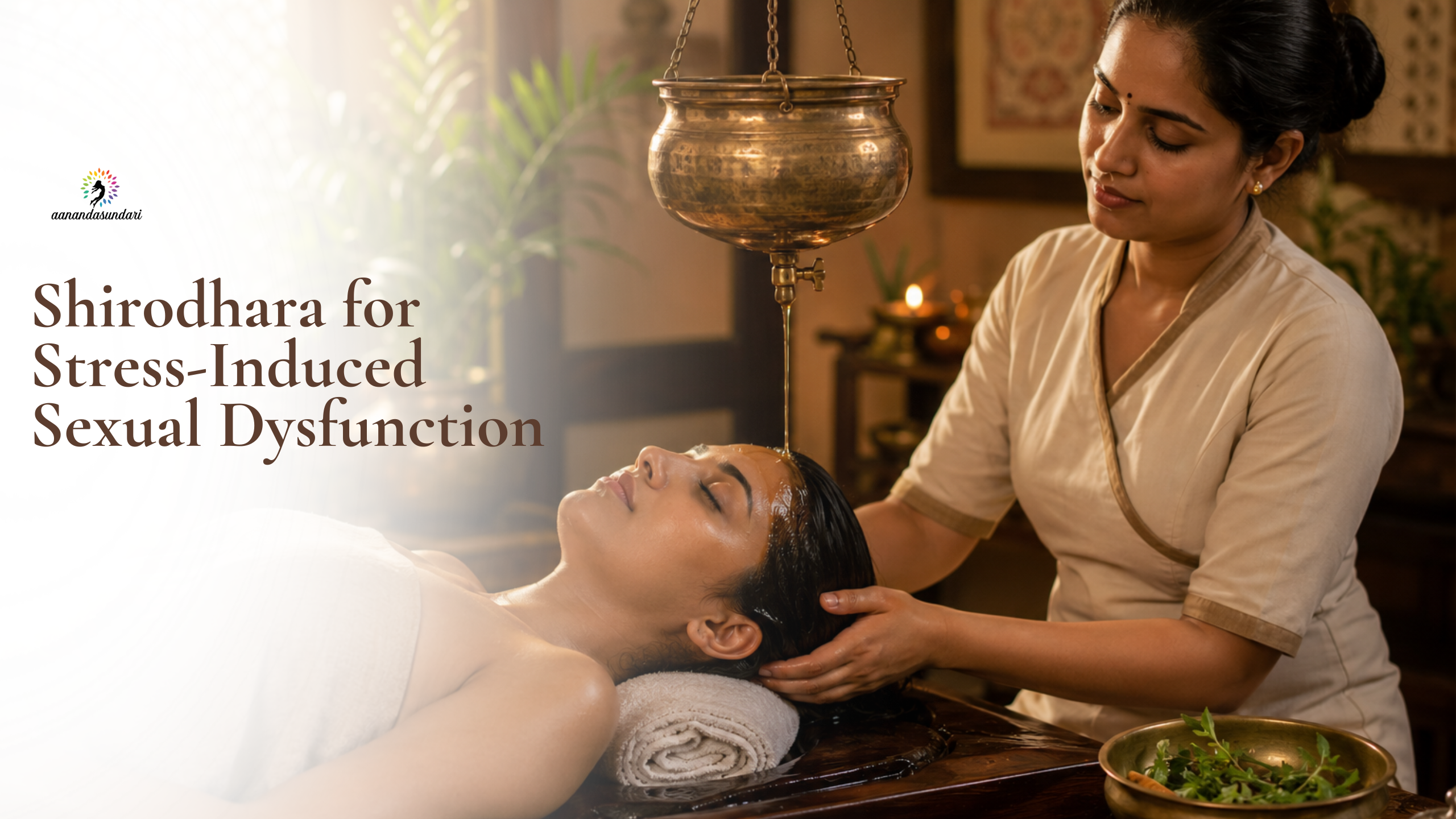
Shirodhara for stress relief, the practice of streaming warm medicated oil over the forehead in a continuous, rhythmic flow, addresses stress-induced sexual dysfunction not by targeting the symptom but by dismantling the cause. This blog explores exactly how, backed by both research and classical Ayurvedic understanding.
The Stress-Libido Circle: Understanding What is Actually Happening
When stress becomes chronic, it triggers a predictable hormonal chain reaction. The adrenal glands release elevated cortisol. The hypothalamic-pituitary-gonadal (HPG) axis, the system that regulates reproductive hormones, gets suppressed as a survival response.
The body, interpreting prolonged stress as a threat, deprioritises reproduction. Estrogen drops. Testosterone (essential for desire in women, not just men) declines. Blood flow to pelvic tissues decreases. The capacity for arousal, lubrication, and pleasure diminishes.
A 2019 review published in the Journal of Sexual Medicine confirmed that HPA (hypothalamic-pituitary-adrenal) axis dysregulation is among the primary physiological drivers of hypoactive sexual desire disorder (HSDD) in women, a condition far more common than most women are told.
In Ayurvedic terms, this pattern corresponds to aggravated Vata dosha, the energy of movement and the nervous system. Emotional stress and low libido in Ayurveda are connected directly to Vata imbalance, which causes dryness, erratic sensations, anxiety, and the feeling of being simultaneously exhausted and unable to switch off.
Stress Trigger
Physiological Effect
Impact on Sexual Health
Cortisol surge
Suppress HPG axis
Low estrogen and testosterone
Sympathetic overdrive
Reduced pelvic blood flow
Poor lubrication and arousal
Sleep disruption
Melatonin/prolactin imbalance
Fatigue, anhedonia, low drive
Mental hyperactivation
Prefrontal overload
Inability to be present during intimacy
Vata aggravation
Erratic nerve signalling
Dryness, numbness, disconnection
What is Shirodhara?
Shirodhara (from Sanskrit, Shiro = head, Dhara = flow) is a classical Ayurvedic panchakarma-adjacent therapy in which warm medicated oil is poured in a continuous stream over the ajna marma, the point between the eyebrows corresponding to the pituitary gland in modern anatomy. Sessions typically last 30 to 60 minutes. The oil is selected based on the patient’s dosha and presenting imbalance.
The forehead is not an arbitrary target. It contains a remarkably dense concentration of cutaneous nerve endings with direct pathways to the limbic system, the brain’s center for emotional processing, memory, and hormonal regulation.
When warm oil is applied in a continuous, rhythmic stream over this area, it creates a specific vibrational and thermal stimulus that quiets the default mode network (the part of the brain responsible for rumination and anxiety) and activates parasympathetic dominance.
The result is measurable. A study published in the Ayu Journal (2014) demonstrated that Shirodhara significantly increased parasympathetic nervous system activity and reduced both subjective stress scores and objective biomarkers of cortisol activity. This is Ayurvedic relaxation therapy for women working at the level of brain chemistry, not merely as comfort but as a clinical intervention.
Shirodhara for Hormonal Balance
One of the most significant and underreported Shirodhara oil therapy benefits is its effect on the neuroendocrine system. The ajna point, the target of Shirodhara, corresponds anatomically to the pituitary gland. The pituitary is the master endocrine gland that coordinates the release of FSH, LH, TSH, and other hormones directly governing female reproductive function.
When the hypothalamus is locked in a chronic stress response, it suppresses GnRH pulsatility, which in turn reduces FSH and LH signaling to the ovaries. Shirodhara for hormonal balance works by interrupting this chain: as the therapy calms the hypothalamic stress response, GnRH signaling normalizes, and the downstream hormonal cascade, estrogen, progesterone, and testosterone, begins to recover.
A 2013 study in the Journal of Ayurveda and Integrative Medicine found that patients receiving Shirodhara showed statistically significant reductions in salivary cortisol alongside self-reported improvements in mood, energy, and physical well-being, all indirect markers of improved HPA-HPG axis communication. `
This is precisely why Shirodhara is considered a natural treatment for stress-related low libido in classical Ayurvedic practice, because it addresses hormonal suppression at its neurological root, rather than treating the hormonal deficit in isolation.
Choosing the Right Oil for Shirodhara Therapy
The medium used in Shirodhara is as therapeutically important as the technique itself. Classical Ayurveda prescribes different oils based on the patient’s dosha, current imbalances, and specific presenting symptoms. For stress-induced sexual dysfunction, the following are most commonly used:
Here’s an oil selection guide for Shirodhara therapy
Oil/Medium
Dosha
Ayurvedic Action
Best For
Tila Taila (Sesame)
Vata
Warming, grounding, nervine
Anxiety, dryness, libido loss
Brahmi Taila
Vata / Pitta
Calms mental chatter, nervine tonic
Overthinking, performance anxiety
Ksheerabala Taila
Vata / Pitta
Hormone-supportive, deeply nourishing
Reproductive fatigue, hormonal gaps
Chandanadi Taila
Pitta
Cooling, anti-inflammatory
Irritability, stress, heat, low libido
Takra
Pitta / Kapha
Detoxifying, clarifying
Mental fog, scalp tension, fatigue
Ksheerabala Taila, in particular, has been referenced in classical texts, including the Ashtanga Hridayam, for its deep neuroprotective and reproductive tissue-nourishing properties, making it especially relevant for women whose sexual dysfunction includes hormonal components alongside nervous system dysregulation.
Final Thoughts
Stress-induced sexual dysfunction is one of the most common and least discussed health challenges women face. It is not a character flaw. It is not inevitable. And it is absolutely not something you simply have to live with.
The Shirodhara benefits documented in research, reduced cortisol, restored parasympathetic activity, improved hormonal signaling, and deepened nervous system calm map precisely onto the physiological mechanisms through which stress suppresses female sexual health. This is not a coincidence. It is a 5,000-year-old clinical system doing exactly what it was designed to do.
When the nervous system finally stops bracing for impact, the body remembers how to receive. Desire, sensitivity, and the capacity for pleasure do not disappear permanently; they go quiet when the system is overwhelmed. Shirodhara for stress relief is, at its core, the act of giving your nervous system permission to stop fighting and start feeling.
At Aanandasndari, our Ayurvedic practitioners specialize in exactly this, creating personalized Shirodhara protocols for women navigating stress-related hormonal disruption and sexual health challenges. We combine classical Ayurvedic precision with a deeply respectful, woman-centered approach. Because your desire, your sensitivity, and your wholeness deserve more than a prescription, they deserve a root-cause solution.