-
CALL: +011 3253 4567
- AANANDA SUNDARI
- May 15, 2026
- 6 MINS READ
There are mornings when no amount of sleep feels like enough. You wake up anxious, your mind already racing before your feet hit the floor. Your mood swings without warning. Your cycle feels like a mystery your own body stopped explaining to you. Sound familiar? If you’re nodding quietly, you’re far from alone.
Millions of women live with this low-grade emotional turbulence and hormonal chaos, often chalking it up to “just stress” or “getting older.” But Ayurveda, India’s 5,000-year-old science of life, has had an answer for this long before modern medicine named it: Nasya therapy.
At Aanandasundari, the revival of this ancient practice is helping women find real, lasting calm without synthetic hormones or dependency-forming medications. This blog explores why Nasya treatment in Ayurveda is gaining serious attention as a tool for emotional resilience and hormonal balance.
What is Nasya Therapy?
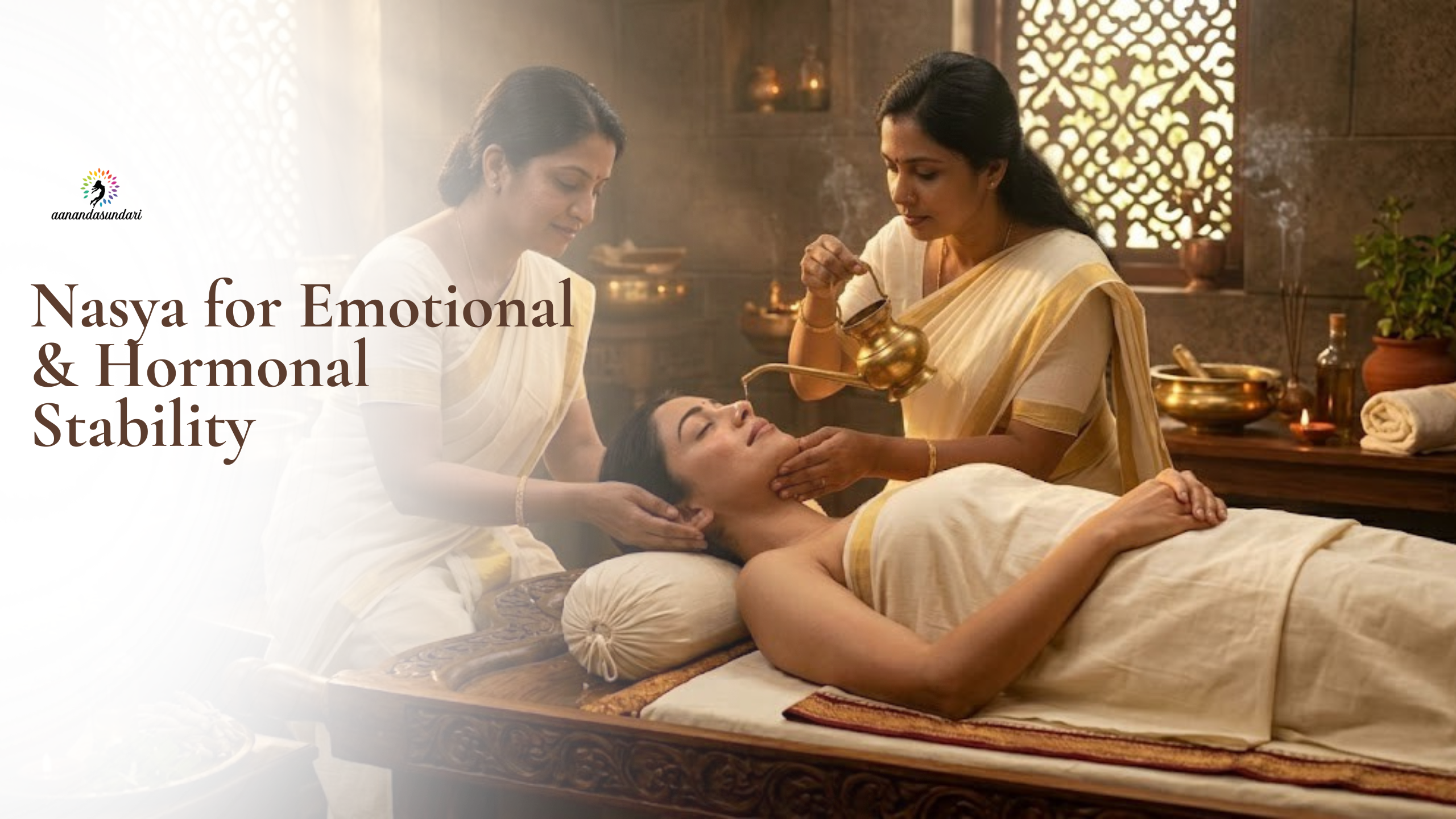
Nasya is one of the five core detoxification procedures in Panchakarma, Ayurveda’s flagship cleansing protocol. The word itself comes from the Sanskrit “nasa,” meaning nose. In practice, Nasya involves the therapeutic administration of medicated oils, herbal preparations, or decoctions through the nasal passages.
In Ayurvedic anatomy, the nose is considered the gateway to the brain, the most direct route to consciousness. The nasal passage leads to the Shringataka Marma, a vital energy junction that connects to the brain, eyes, ears, and throat. By introducing medicine through this channel, Nasya works deeply on the nervous system and the endocrine glands that regulate hormones.
The Science Behind Nasya Therapy Benefits
Modern research is beginning to validate what Ayurvedic physicians have known for centuries. The nasal route offers one of the fastest paths to brain-active compounds, largely because it bypasses the blood-brain barrier, a protective wall that blocks most orally ingested substances from reaching the brain.
A study published in the Journal of Ayurveda and Integrative Medicine (2019) observed that Nasya with medicated sesame oil significantly reduced anxiety scores and improved sleep quality in patients with stress-related disorders over 21 days.
Another trial documented in Ancient Science of Life found that Pratimarsha Nasya (a gentle daily Nasya form) improved cognitive function, reduced fatigue, and stabilized mood in women experiencing perimenopause.
How Nasya Affects the Body’s Key Systems
System | Nasya’s Action | Outcome |
Central Nervous System | Calms Vata dosha, reduces nerve overactivity | Reduced anxiety, mental clarity |
Endocrine System | Influences the pituitary and hypothalamus via the olfactory pathway | Better hormonal signalling |
Limbic System | Aromatic compounds stimulate emotional regulation centers. | Mood stabilization |
Sleep-Wake Cycle | Reduces cortisol, promotes melatonin balance | Deeper, restorative sleep |
Respiratory Mucosa | Clears Ama from upper channels | Improved oxygen supply to the brain |
Nasya for Stress: Addressing the Root Cause
Modern medicine largely treats stress through the HPA (hypothalamic-pituitary-adrenal) axis, suppressing cortisol spikes through medication. Ayurveda approaches it differently.
In Ayurvedic understanding, chronic stress is primarily a Vata aggravation, an excess of the air-and-space element that governs the nervous system. An imbalanced Vata manifests as racing thoughts, irregular sleep, dry skin, erratic digestion, and emotional hypersensitivity. Left unchecked, aggravated Vata disrupts Pitta (the fire element governing hormones and transformation) and Kapha (the earth element responsible for stability and immunity).
Nasya for stress works by directly pacifying Vata in the Urdhva Jatru (the region above the shoulders). Warm, unctuous medicated oils, most commonly Anu Taila, Shadbindu Taila, or plain sesame oil, are gently administered into each nostril. The oil nourishes the nasal mucosa, soothes the cranial nerves, and begins signaling the parasympathetic nervous system to shift out of “fight-or-flight” mode.
Most patients report feeling a noticeable calm within the first session, a rare outcome in any therapeutic modality.
Hormonal Imbalance: The Ayurvedic Lens
Hormonal imbalance is not simply a chemical problem in Ayurveda; it is a systemic disharmony rooted in dosha imbalance, weak digestive fire (Agni), and accumulation of metabolic toxins (Ama).
For women, the reproductive hormones, estrogen, progesterone, cortisol, and thyroid hormones, are all intimately linked to the state of the Ojas (vital essence) and the balance of the three doshas. When Vata is chronically elevated due to stress, poor sleep, or erratic lifestyle, it impairs the Artava Dhatu (reproductive tissue) and disrupts the hypothalamic-pituitary-ovarian axis, the same axis endocrinologists focus on.
Panchakarma Nasya therapy acts upstream on this axis. Calming the nervous system and reducing stress-driven cortisol overload, it creates the biochemical space for estrogen and progesterone to find equilibrium.
Common Hormonal Complaints Addressed by Nasya
Condition | Predominant Dosha | Role of Nasya |
PMS and mood swings | Vata + Pitta | Calms the nervous system and reduces inflammatory Pitta |
Irregular periods | Vata | Restores rhythmic Vata movement in the pelvis |
PCOS-related anxiety | Kapha + Vata | Clears Kapha obstruction, soothes Vata |
Perimenopausal symptoms | Vata | Nourishes depleted Vata, reduces hot flashes |
Thyroid dysregulation | Pitta + Kapha | Supports throat Marma, balances metabolism |
Insomnia from hormonal shifts | Vata | Induces parasympathetic calm, improves Ojas |
What to Expect During a Nasya Session?
A full Panchakarma Nasya therapy session typically follows this sequence:
- Abhyanga (Oil Massage) on the face, neck, and shoulders to warm the tissues
- Swedana (Steam) is applied gently to the face to open the channels
- Nasya Administration: medicated oil drops instilled in each nostril while lying back with the neck extended
- Post-therapy Rest: 5–10 minutes of stillness to let the medicine absorb
- Gargling with warm water or an herbal decoction to clear drainage
The session lasts 30–45 minutes and is deeply relaxing. Most Panchakarma protocols recommend 7 to 14 consecutive days for therapeutic effect, though many patients notice changes within 3 sessions.
Final Thoughts
The link between your nose and your hormones isn’t a poetic metaphor; it’s physiology. The olfactory pathway is a direct neural highway to the brain’s command centers. The hypothalamus, which receives signals through this route, is the master regulator of both the stress response and the reproductive hormone cascade.
Ayurvedic nasal therapy understood this long before modern neuroscience had the vocabulary to describe it. And in a world where women are increasingly navigating burnout, hormonal disruption, and emotional exhaustion without satisfactory answers, Nasya offers something rare: a therapy that is gentle, non-invasive, deeply calming, and rooted in thousands of years of clinical observation.
At Aanandasundari, our team of experienced Ayurvedic physicians offers personalized Nasya treatment programs designed around your unique constitution and health goals. Whether you’re seeking relief from stress, support through perimenopause, or simply a deeper quality of rest, we combine the precision of classical Ayurveda with a warm, unhurried approach to healing.
You don’t have to keep managing. You can actually heal.